Stop Asking "Should I Keep This?" — Ask These 3 Questions Instead
If you've ever spent 20 minutes staring at a box of stuff trying to decide whether it stays or goes, you already know the problem. The question "Should I keep this?" is useless. It's too open, too loaded with guilt, memory, and vague future possibility. It sends you in circles.

What actually works is a decision framework. A simple sequence of questions that takes the emotion out of it — or at least puts the emotion in the right place.
Here's the one I use.
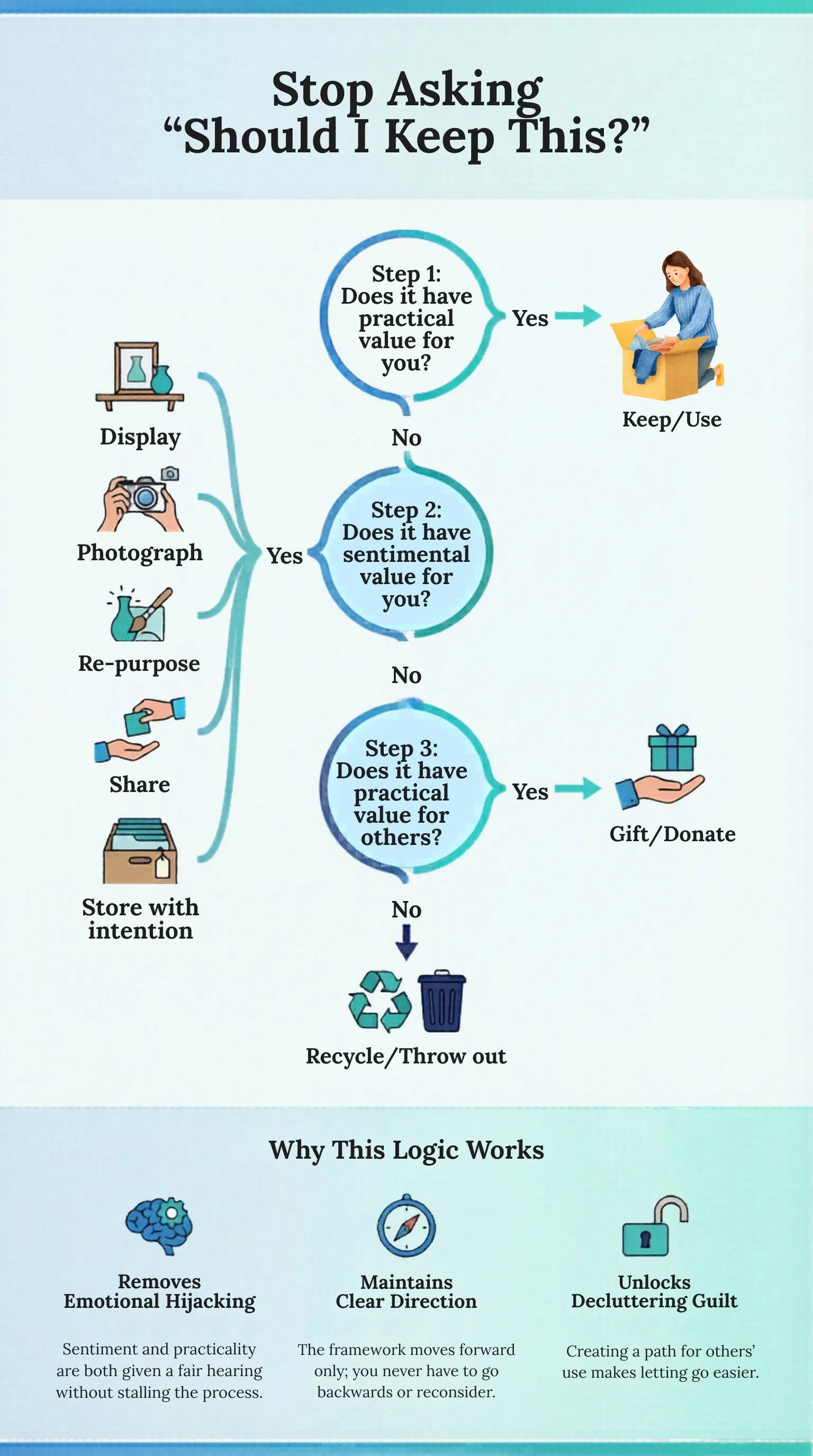
Question 1: Does this have practical value for you?
Not "could it theoretically be useful one day." Does it actually serve a function in your life right now? If yes — keep it, use it, done.
If no, keep going.
Question 2: Does this have sentimental value for you?
This is where a lot of people get stuck, and that's OK. Sentimental value is real. But it's also worth being honest about what you're actually going to do with that value.
If yes, you've got some genuine options beyond "shove it in a box": display it, photograph it so the memory is preserved without the object taking up space, re-purpose it into something you'll actually use, share it with someone who'd appreciate it, or store it with intention rather than by default.
If no — it's not practical, it's not sentimental — keep going.
Question 3: Does this have practical value for someone else?
This is the question that unlocks the guilt. Just because something no longer serves you doesn't mean it has no value. Could you gift it? Donate it? If yes to either, it goes out the door into better hands.
If no — not useful to you, not meaningful to you, not useful to anyone — it's time. Recycle it or throw it out—no more deliberating.
Why this works
The framework works because it gives every item a fair hearing without letting any single consideration hijack the whole decision. Sentiment gets a turn, but so does practicality. And "might be useful to someone" gets named as a real path, not just a vague excuse to keep things.
It also moves in a clear direction. You're not going backwards or reconsidering. Each question either resolves the decision or hands it to the next one.
The infographic below maps it out visually — print it, stick it on the wall, and use it next time you're knee-deep in a declutter.
If you'd like help getting organised — whether that's a physical space, a business process, or somewhere in between — I'd love to have a chat, contact me here - explore@sarahgillis.com.au